Getting Stuff Done
Getting Stuff Done
This Guide aims to introduce you to the way we "get stuff done" (e.g. work) at Life Itself.
For now, rather than an overall systematic approach, we share some of the key patterns we use:
- Issues and Tasks
- Patterns for Meetings
- Getting things Done (David Allen)
- "Shaping and Shipping" (see below)
The shape and ship model below is no longer formally used at Life Itsef. However, the terminology and concepts are still relevant so it is worth looking at. (Originally developed in Jan/Feb 2024)
Overview of Shape and Ship
We use a "Shape and Ship" model. This is inspired by Basecamp's ShapeUp.
In the "Shape and Ship" model, items pass through a process which starts from a raw idea and results in a "shipped" item.
The diagram below illustrates the key components of this process.
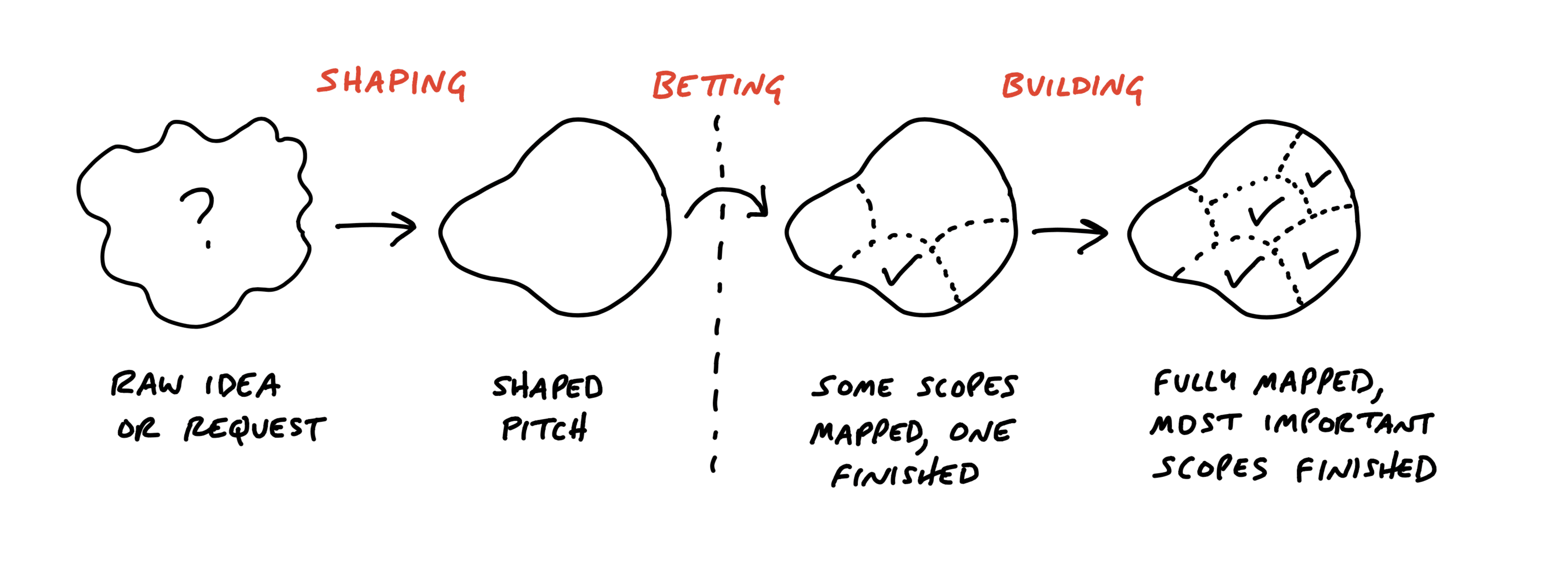
There is selection at each stage: only some raw ideas are shaped and only some shaped ideas are selected ("bet on") to be shipped.
Ideas inbox
Raw ideas are captured in an inbox. Ideas for projects or other work items may be generated in a team brainstorming session, and are also captured on an ongoing basis as they come up. In general, idea generation tends to be guided by the Life Itself Strategy, by previous work, and by what team members feel inspired to work on within the broader strategy.
Shaping
Shaping is a pattern for creating pitches that can be selected ("bet on").
It involves clearly framing the problem or underlying need to be addressed, and defining the key elements of a solution, before deciding to commit to a project ('selection') and start working on it ('shipping').
The output of the shaping process is typically a 'pitch', i.e. a document outlining a shaped proposal for a project, which can used in the selection (betting) process.
Read more about how we shape work at Life Itself here. TODO: link to section below
Selection
Selection (aka 'betting') is about deciding to commit to delivering one or more shaped projects during the current cycle. We will typically review the pitches that were created in the Shaping phase, and decide which ones we want to deliver during the next shipping phase.
Shipping
During the shipping phase, we deliver a (set of) shaped idea(s) that we selected during the selection or betting phase.
How it fits together timewise
As a team we work together in 4 week cycles that are split into two phases.

This schedule differs from the one detailed in ShapeUp. See #Shaping cycle is different
Walking through an example month
Let's assume we are starting with a shape cycle:
- For the next two weeks we are busy shaping and then selecting what we'll do next. It's also a cooling off period where we have time to follow up on things, resolve minor issues etc.
- At the end of this we have a clear sense of what we are shipping the following two weeks
- For the next two weeks, we focus on shipping the selected item(s). Each person will be part of one and only one project and with their team-mates will focus on shipping that with minimal distractions
Key features of Shape and Ship model
In conclusion, it is important to flag some key features of this approach:
- ShapeUp: Extensive shaping before selection (betting). Raw ideas must be shaped before they are put forward for selection and worked on. Dedicated time and personnel are assigned to shaping.
- Appetite rather than features: define work by appetite rather than desired features. Fix our appetite based on our "ship" iteration length and stick to that ie. reduce scope to fix that appetite.
- Focus during shipping: (largely) uninterrupted periods of work for shipping where we eliminate most outside distractions. We have a separate cool-down/bet period (where we tie up loose ends / clear inboxes and bet on next projects). We allow some interrupt time during shipping (hopefully minimal)
- Respect the scope: adhere to the appetite, avoid no-goes and rabbit holes.
- Exclusive teams per project: in a given iteration a person is working on one and only one project
- Not required to have everyone work on same project
- what about small consultation etc - that's allowed as interrupts. and some people may need a bit of an exception.
Challenges to focus in the ship cycle
To hold up "in reality" we need to handle various issues that can come up such as "interrupts" and "overruns".
- Interrupt: something important that requires immediate attention e.g. new work/opportunity with external deadline.
- Overruns: work takes longer than anticipated
- Trickling items: ongoing, small items e.g. a regular team call or similar.
Handling interrupts
First, ask yourself does this really have to be handled right now? Is it a crisis? Most items are not crises and they can wait until the next cool off period.
We can also budget some time for interruptions in a Ship cycle e.g. Friday afternoons or similar where you can schedule calls, catch up with urgent items etc.
Handling trickling items
First, try to minimize these during Ship cyles. Second, budget for them and try to have these concentrated in a specific time slot (with same time slot for whole team).
As the team grows larger it may also be possible to have a few people who handle these regular, trickling items e.g. hosting certain calls.
Handling overruns
Overruns don't happen because we fix appetite and we have shaped sufficiently. We aim to ship what we have done and if it isn't good enough to ship we leave it - it can potentially come back again in future shape and select rounds.
Handling underruns
Under-runs are rare 😉 and they do happen. If they happen, usually we can pull some bugs or day to day tasks out of the backlog and do them.
Handling different projects with different needs
We may have ongoing projects whose work chunks are longer than ship cycles. How do we handle this?
Longer projects are split up into smaller chunks so that they can fit within ship cycles. Conversely, smaller chunks are bundled together to make a ship cycle.
Handling new ideas during shipping
Be very careful about increasing scope during ship. Some new things will always come up because a shape is a rough sketch. But be careful. Generally, capture new items to an inbox area and evaluate them. If they aren't part of the scoped work capture them for a later phase of shaping.
Howtos
Shaping Howto
For an introduction to how to shape see shaping notes.
Key links:
- Ideas inbox: https://github.com/life-itself/comms/blob/main/IDEAS.md
- Pitch folder: https://github.com/life-itself/comms/tree/main/pitch
Pitch submission and review
- Create a pitch as a markdown file using the template below
- Post it in the pitch folder.
- BONUS: Submit the pitch as using a pull request as that allows for nice review and annotation.
Template for a Shaped proposal
The following is a markdown template for the pitch that results from the shaping work.
Pitch format aligns with the situation, complication, question and hypothesis format. In fact, we recommend using the SCQA to generate the pitch. We recommend including the question (if you have one) into the problem section.
## Summary

*Aim for bullet points with 1-3 sentence summary of other sections. Fill this in near the end.*

- **Appetite**:
- **Situation**:
- **Problem**:
- **Solution**:

## Situation

*Context for this problem and solution*

## Problem


### Questions


## Solution


## Rabbit Holes


## No Gos


## Appendix

e.g.

- Other potential solutions we didn't go for
- Detailed issue trees
- Full consolidated scqa if you want it etc
Selection Howto
Selection is currently done by Rufus with the input of the team. This may evolve in future as we see how things go.
Raw ideas are selected for shaping by the team as group at the start of a shape cycle.
Shipping Howto
Self-organize using our recommended patterns.
Within Ship cycles you and your team self-organize using our recommended patterns.
Patterns
- Use issues
- Have an epic issue for the overall effort
- Organize into sub iterations sprints. (Especially if Ship cycle is 4w or longer)
- Standup
- Roles e.g. Product Owner, Scrum Leader
Appendices
Appendix: Concrete examples
A long-running externally connected project
How would this apply to an EU Funded project?
- It's "shaped work" (it's not trickling or an interrupt or overrun)
- Do shaping on initial project. Then shape each chunk of work you do.
- Then do those.
- What about when gaps e.g. waiting for feedback do some shaping or gap-filling work?
Interrupt example: time sensitive bizDev opportunity
- This is an interrupt
- Evaluate it rapidly for cost/benefit
- Schedule into interrupt time in day
- Keep an eye on interrupt budget
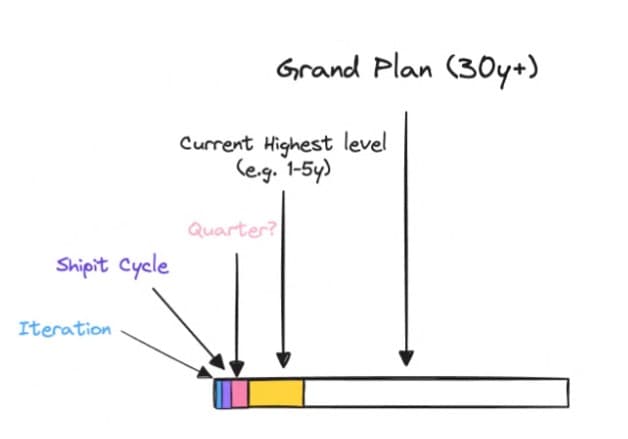
Appendix: Larger context of work and quarterly and annual check-ins
This
- An 'annual meeting' in early January
- Quarter planning can be a 'check in point'
Appendix: how shape and ship differs from other approaches
How does Shape and Ship differ from e.g. agile that we had before, or our project A10 model, or …
Appendix: differences from standard ShapeUp
Shaping cycle is different
